WordPress Publishers Deserve Better Ad Infrastructure
Why traditional WordPress ad plugins fail modern publishers. A founder's reflection on speed, operational visibility, and modern monetization workflows.
Every day, thousands of modern WordPress publishers make a silent, frustrating compromise. They spend weeks optimizing their servers, cleaning up CSS stylesheets, and compressing images, only to watch their Core Web Vitals get decimated the moment they activate their ad monetization scripts.
The industry has accepted this as the cost of doing business. We are told that if we want to run programmatic ads, we must accept slow page speeds, layout shifts, and high bounce rates.
But this trade-off is artificial. The real problem isn’t the ads themselves. It is that most ad plugins are built as outdated utilities rather than core publisher infrastructure.
In simple terms, WordPress ad infrastructure refers to the underlying engineering pipeline that governs how ad scripts are loaded, executed, and monitored on a website. It is the bridge between a publisher’s content database and programmatic demand partners. When this bridge is built on legacy tech, the entire site suffers.
The Fragmentation of Traditional WordPress Ad Infrastructure
For years, the standard ad management workflow in WordPress was simple: copy a script block from Google AdSense, paste it into a widget or a basic insertion plugin, and let it run.
But the WordPress monetization workflow has evolved dramatically. Today, growing publishers aren’t just pasting a single banner script. They are managing complex header bidding wrappers, configuring Google Ad Manager keys, setting up lazy loading thresholds, and segmenting traffic across supported networks.
Yet the tools we use to manage this complexity look and feel like they were designed in 2012.
If you have ever opened a legacy ad plugin, you know the feeling. The interface is a cockpit of 16 different tabs, filled with confusing regex rules, PHP hooks, and overlapping settings. It is easy to make a small mistake that takes down your ads or breaks your site’s layout entirely.
More importantly, these plugins treat ads as isolated widgets. They don’t understand how your ads interact with your theme, your cache, or your visitor’s browser. They place the code and then walk away, leaving you in the dark.
The Hidden Costs of Outdated Utilities: Performance & UX
When you run an outdated ad utility, you pay for it in speed and user experience.
Most legacy tools inject ads synchronously into your DOM. When a visitor lands on your site, their browser is forced to pause rendering the article while it fetches, parses, and executes third-party ad scripts. This blocks the main thread, resulting in a poor Largest Contentful Paint (LCP) score.
Even worse is the layout instability. When an ad script loads late, it suddenly pushes the content down, causing a massive Cumulative Layout Shift (CLS). This doesn’t just frustrate your readers; it directly harms your Google search rankings.
Decoupled Ad Injection
Loads page content first, then injects ad slots asynchronously. Your page loads instantly, and ads render seamlessly without blocking the main thread.
Most publishers never think about this layer because plugins traditionally never exposed it. The page content should render immediately. Ads should be placed into pre-allocated layout containers that load asynchronously post-render. This stabilizes the viewport, protects Core Web Vitals, and keeps the page feeling fast.
Stop letting legacy ad scripts hijack your page speed
Deploy AdVajra's async-first engine to deliver ads post-DOM render. Keep your Core Web Vitals green and protect your organic search traffic.
Download Free ↗Why Modern WordPress Publishers Need Operational Visibility
The most dangerous part of traditional ad plugins is what they don’t tell you. They operate as a black box.
When you configure an ad unit, the plugin does its job by printing the script to the page. But it doesn’t verify if an ad actually rendered.
If Google AdSense or your header bidding partner returns a blank response, or if the ad fails to load due to network latency, the plugin is blind to it. Your visitor sees a large empty space, and you get a wasted impression. This is known as revenue leakage, and it quietly drains hundreds or thousands of dollars from publishers every single month.
Operational visibility means establishing a feedback loop. A modern ad management setup should strive to actively audit every ad slot. Knowing if an ad unit fails to load or experiences latency is key to maximizing revenue.
This level of tracking is crucial when optimizing your ad layout, where viewability and fill rates dictate overall yield. Without this visibility, publishers are forced to optimize in the dark, which is why we’re focusing our engineering roadmap on solving these exact reporting blindspots.
Why We Built AdVajra: Decoupling AdOps from Content Management
Before building AdVajra, I spent years working deeply within high-traffic publisher environments and ad-tech systems. Time after time, the pattern was the same: editorial teams would write great content, dev teams would optimize the codebase, and then the monetization team would load heavy, unmanaged scripts that ruined the page experience.
When we compared existing tools with our vision for a clean, React-powered, async-first engine, we realized that choosing the right architecture represents a fundamental choice of philosophy. We didn’t want to build another Swiss Army knife utility that required a degree in PHP config to operate. We wanted to build true infrastructure.
AdVajra was designed to solve these structural issues from the ground up. By separating the ad administration interface into a fast React Single Page Application (SPA) dashboard, we eliminated administrative lag. By rebuilding the script pipeline to load asynchronously, we protect user experience and page speed. (Check our pricing page to see how our pro plans expand on these core design philosophies.)
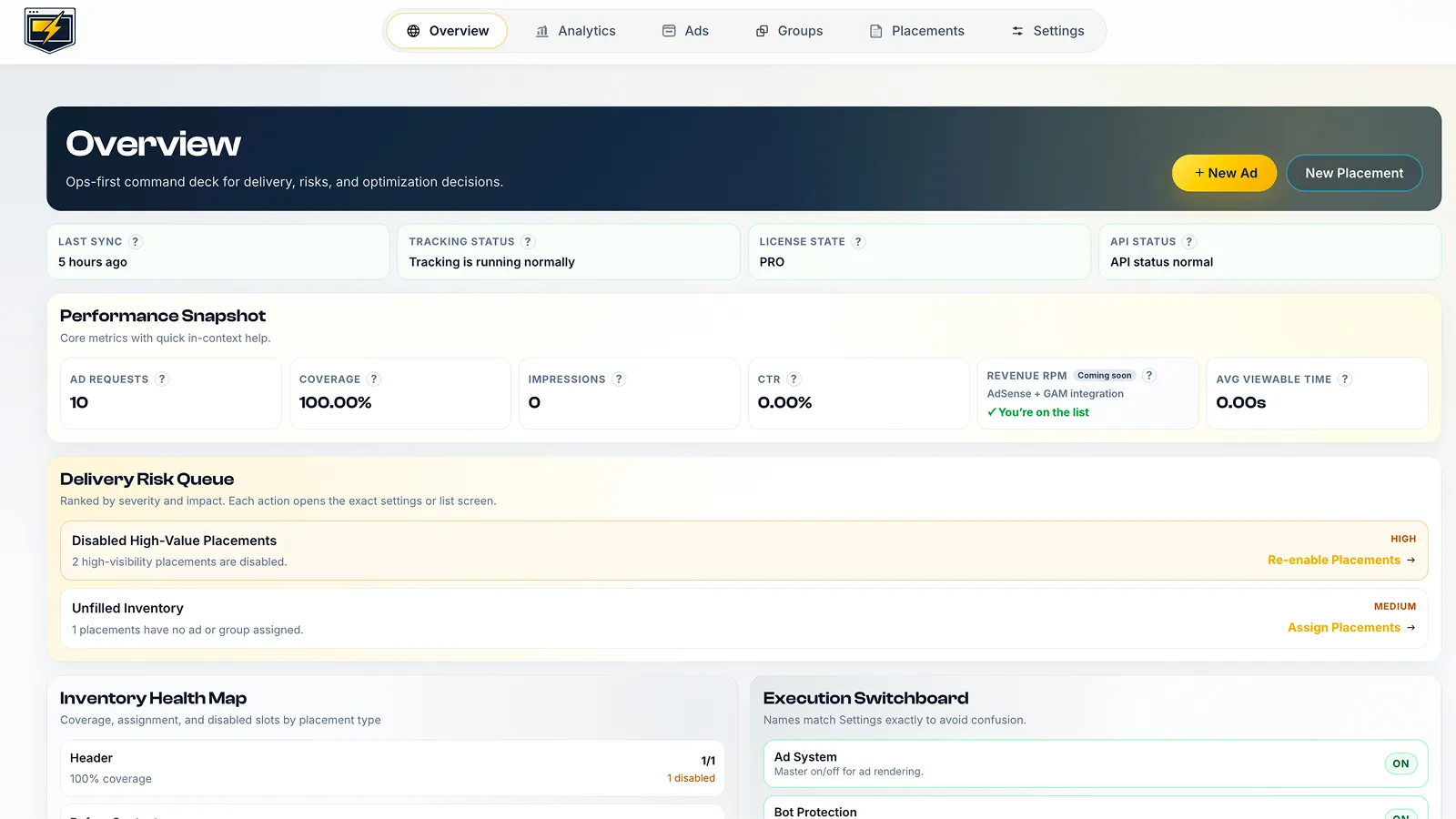
We also built the Delivery Risk Queue directly into the core platform. Instead of hoping your ads are loading, AdVajra actively monitors each slot. If a layout shift is detected, or if a placement returns blank impressions, you receive a dashboard alert immediately.
The Future of WordPress Publishing
The web is changing. Search engines are prioritizing user experience more than ever, and AI-driven search demands fast, stable pages. The publishers who succeed in this environment will be the ones who treat their monetization setup as modern engineering rather than an afterthought.
You shouldn’t have to choose between keeping your site fast and keeping your business profitable. Your ad plugin should protect both.
This is the exact philosophy behind AdVajra. We built it to give publishers the modern, high-performance ad infrastructure they deserve.
Stop leaving ad revenue on the table.
Get the Delivery Risk Queue, Click Fraud Protection, AdBlock Recovery and more.