Why Most WordPress Ad Workflows Still Feel Broken
Why traditional WordPress ad management systems frustrate publishers. A founder's take on shortcode chaos, script bloat, and the need for modern ad operations.
Every day, digital publishers face a hidden tax on their operations. For a growing content business, server configurations, design layouts, and publishing cadences are carefully controlled—yet when it comes to WordPress ad management, the day-to-day workflow still feels fundamentally broken.
Publishers are forced to manage a highly sophisticated programmatic ad stack using administration tools that feel stuck in the early 2010s. We load multiple plugins, copy and paste scripts from various networks, and hope that our page layouts don’t shift.
The trade-off is exhausting: we choose between maintaining a fast, stable page experience and generating enough revenue to keep our business alive.
The root of this issue isn’t the ad networks or the programmatic partners. It is that the industry has treated ad delivery as a series of simple widget placements rather than modern, performance-aware publisher infrastructure.
The Structural Breakdown of the Traditional Ad Management Workflow
If you run a high-traffic site, you are likely using a traditional WordPress ad plugin or WordPress ads plugin to handle your placements. What starts as a simple setup eventually degenerates into operational chaos.
This fragmentation manifests in three specific ways:
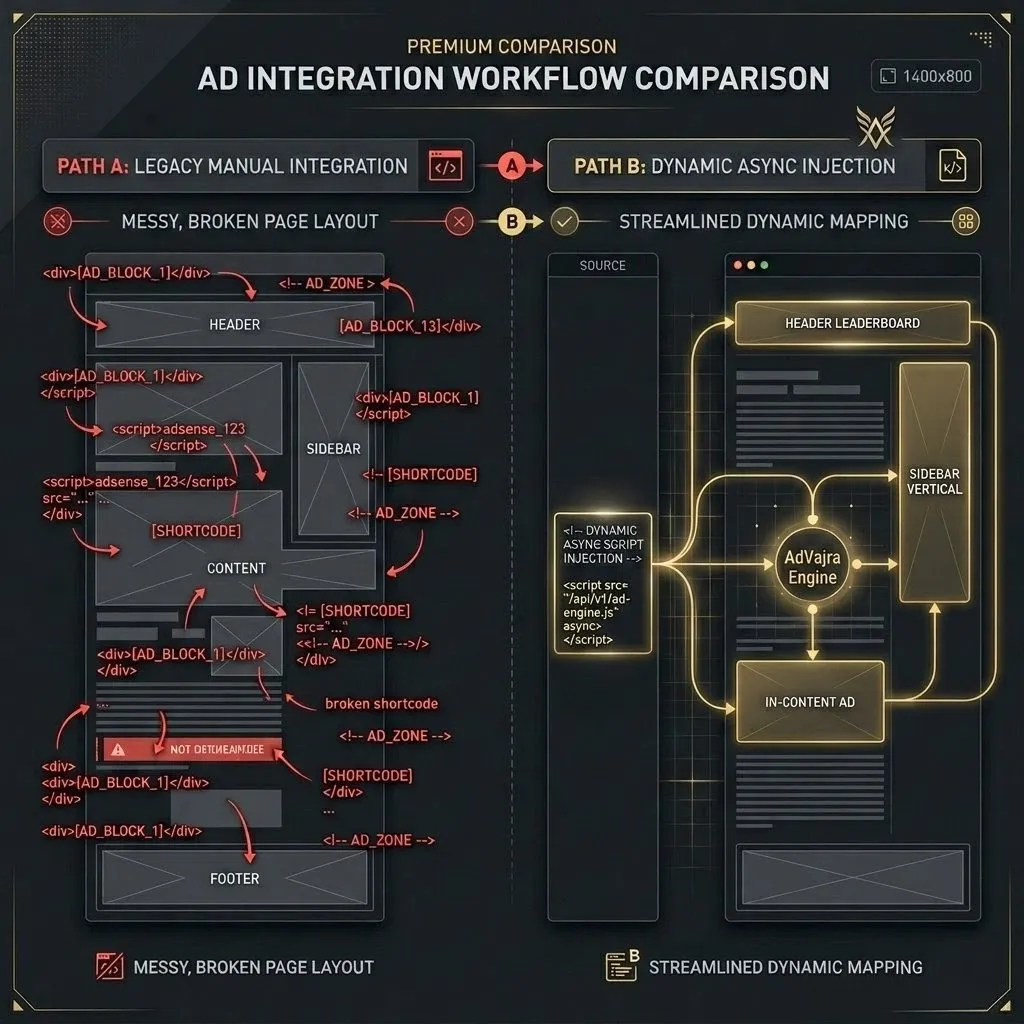
- Shortcode Chaos: Inserting a shortcode directly into your post content or template files makes site redesigns and layout audits an operational hazard. If you want to change how or where your ads are served, you have to manually hunt down every reference.
- Scattered Plugin Settings: Legacy dashboards require you to navigate dozens of tabs, raw PHP code insertion boxes, and nested configuration screens just to adjust basic
ad placements WordPressrules. One wrong save can break your database rendering or take down your entire ad stack. - Fragmented Stack Execution: The average WordPress publisher workflow involves coordinating Google AdSense, direct advertising contracts, and complex header bidding auctions. When these are handled by disconnected widgets, the scripts compete with each other, bloating the browser main thread and destroying site performance.
This is not a scalable ad management workflow; it is a series of fragile workarounds. Without a centralized way to orchestrate your inventory, your team ends up managing monetization blindly.
The Hidden Costs: Poor Operational Visibility & Performance Lag
When your ad scripts are unmanaged, you pay for it in SEO traffic and lost yield.
In a traditional setup, the ad plugin prints the ad tag into the page HTML. But it has no idea if the ad server returned a blank impression, if the network timed out, or if the visitor is using a strict ad blocker.
Because the plugin is blind to the outcome, it continues to reserve empty layout blocks or serve heavy, non-rendering scripts. This is a primary driver of revenue leakage, where publishers serve blank space instead of high-yielding fallback banners or subscription CTAs.
Furthermore, traditional script injection blocks the DOM rendering pathway. When a browser pauses to fetch and parse external scripts, your Largest Contentful Paint (LCP) time spikes. If the ad script loads late and suddenly forces content downward, your Cumulative Layout Shift (CLS) score degrades, directly harming your search visibility.
Managing your WordPress monetization stack requires moving away from local PHP script injection toward a decoupled delivery pipeline.
Moving to Modern WordPress Ad Management
To fix these structural issues, publishers must change how they think about script execution. We need to treat ad delivery as WordPress ad operations (AdOps), rather than a side-effect of content management.
This means transitioning from scattered shortcodes to modern publisher infrastructure. The page DOM should render instantly, and ad scripts should be loaded asynchronously via a single, performance-optimized execution engine.
The Execution Switchboard
Allows publishers to dynamically disable unused monetization modules, serving zero bytes of script overhead on pages where ad units are not rendered.
By decoupling script execution, you ensure that third-party ad networks cannot block your site’s rendering cycle. It stabilizes your layouts, preserves your Core Web Vitals, and ensures your pages load instantly for visitors.
Rebuilding Your WordPress Ad Operations Workflow
When we began building AdVajra, our goal was to replace the fragmented cockpit experience of traditional plugins with a fast, modern system. We realized that a high-performance publisher monetization workflow needs the same level of UI speed and reliability as a SaaS platform.
By shifting the administration interface into a React-powered dashboard, we eliminated the lag of legacy WordPress settings screens. This allows teams to visually map ad placements, configure targeting, and audit inventory health instantly without full page reloads.

We also built the platform to route all programmatic auctions, header bidding rules, and network tags through a single async injection point. This reduces main thread blocking and stabilizes Cumulative Layout Shift (CLS). (Check our pricing page to see how our pro plans expand on these core design philosophies.)
If you want to understand how this decoupled script delivery model compares to legacy architectures, read our reflection on why WordPress ad infrastructure must be treated as core site architecture.
Reclaiming Your Monetization Stack
The web is moving toward faster page loads, and search engines are rewarding publishers who prioritize user experience. The publishers who succeed will be the ones who treat their monetization setups as engineering, not just a configuration task.
You shouldn’t have to choose between a fast website and a profitable business. Your WordPress advertising management tool should protect both.
If you are ready to modernize your publishing setup, explore our core features or review our support and operational documentation to see how AdVajra can help streamline your daily operations.
Stop leaving ad revenue on the table.
Get the Delivery Risk Queue, Click Fraud Protection, AdBlock Recovery and more.